Showing posts with label change. Show all posts

Sunday, October 03, 2010

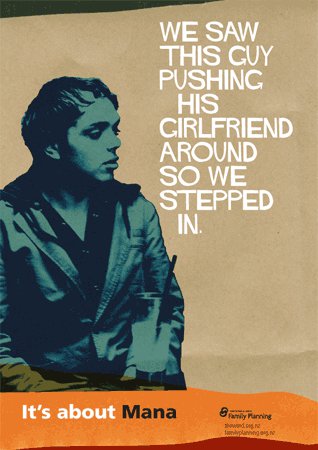
It's all about Mana


Family Planning NZ has picked up an overseas idea and made it their own (think this is called ‘contextualization’ – one word I’ve learned while working at National Mission! LOL).
They’re calling the programme It’s about Mana, and it’s intended for young men – those in the later stages of schooling and beyond – with the hope that they’ll question traditional male values: the idea that real men are always in control (but have uncontrollable sex drives); deserve entitlement or respect, and that women are objects, amongst other things. Holding these ideas up to the light is intended to work against relationship violence. “If young men are involved in discussions that show that most men don’t use or condone violence towards women, this will make it harder for violent individuals to justify it as normal behaviour.”
Read more on the Family Planning site or join the Facebook page.

And more on the same topic. There’s a very interesting report from the International Planned Parenting Federation called Men are Changing. While personally I’ve had some qualms in regard to the work of the IPPF over the years, this report is essentially positive and shows that a great deal of important work is being done in regard to the way men see themselves and their relationships to women - and other men. The interesting thing about this report is the case studies for once don’t come from European or North American contexts (there is a Canadian one) but from African, South American and Asian countries.
You can download the pdf here.

Monday, July 12, 2010

God and organisational development

Part of the reason at least, is that some Christian OD [organisational development] work is functionally agnostic, if not atheistic. Our strategy or team-building exercises, for example, are sometimes no different from a secular process. We treat them as simply technical processes. By keeping our faith separate from our OD work, we practice OD as if God was not interested or involved in human change. We try to change our church organisations in our own strength alone and end up exhausted and disillusioned.

Rick James in Creating Space for Grace: God's power in organisational change. [Available as a pdf download from the Swedish Mission Council.]

Sunday, July 04, 2010

Mission is Messy

In an article entitled Why we must shift our attention from ‘save newspapers’ to ‘save society’ by Clay Shirky, he notes that when Guttenberg invented the printing press, the results were initially chaotic...
“Only in retrospect were experiments undertaken during the wrenching transition to print revealed to be turning points.....That is what real revolutions are like. The old stuff gets broken faster than the new stuff is put in its place. The importance of any given experiment isn’t apparent in the moment; big changes stall, small changes spread. Ancient social bargains, once disrupted, can be neither mended nor quickly replaced, since any such bargain takes decades to solidify…
“And so it is today. When people demand to know how we are going to replace [all kinds of things- add your favourite institution here] .. they are demanding to be told that the old systems will not break before new systems are in place. They are demanding to be told that ancient social bargains aren’t in peril, that core institutions will be spared, that new methods of spreading information will improve previous practice rather than upending it. They are demanding to be lied to.
“There are fewer and fewer people who can convincingly tell such a lie.....The future is already here. It just isn’t evenly distributed.”

Why have I headed this post 'Mission is Messy?' Because what Shirky discusses is very similar to the way mission works, the way the 'emerging' church works (and you can think of 'emerging' in any way you like), and even the way a person converted from the old life into a Christ-life 'works'. Though the article focuses on the on-going crisis seen in the newspaper industry, it has resonances far beyond that.

Thanks to Len Hjalmarson for bringing this to our attention.

Sunday, May 09, 2010

Facing change

When internal and external alignment is lost, the organization faces a choice: either adapt or take the road to slow death. Usually the organization can be renewed, energized, or made effective only if some leader is willing to take some big risks by stepping outside the well-defined boundaries. When this happens, the organization is lured, pushed, or pulled into unknown territory The resulting journey through the unknown is a terrifying experience, with the possibility of failure or death a reality rather than a metaphor.

From the opening chapter of Deep Change: discovering the leader within, by Robert E Quinn.

Does this sound like a church you know?

Thursday, April 29, 2010

Challenge of Change (and an apology!)


Just by way of apology: things have been a bit quiet on this blog lately due to a number of other calls on my time at the National Mission Office. Nil desperandum! The blog is not forgotten, and just to prove it, here's a review of a book for you.

The Challenge of Change: a practical guide to shaping change and changing the shape of the church, by Philip Potter.
The following review comes from Amazon.co.uk and is by P E Berry:
I'm an Anglican Vicar with over 15 years of experience in three different parishes/teams and I have to say that Phil Potter's book is probably one of the most important and influential I've read in the whole of that time. Thoroughly grounded on Phil's experience over many years, it is not triumphant about achievements (as so many tend to be) but, rather, incredibly honest and realistic, both about his early days at St. Mark's, Haydock and how he guided this church along the often painful road of change. It's well grounded in a Biblical understanding of what it means to be God's people and also extremely practical in applying those all-important foundational principles on which to help build a healthy approach to change. This book has really 'spoken' into my current situation, so much so that I've bought it for the staff team and will be using it as a basis for a PCC vision day. I don't think I exaggerate when I tell people that it has transformed my ministry. Highly recommended.
(The book comes from an Anglican perspective but can be applied well beyond that. There are challenging exercises at the end of each chapter.)
Published by the Bible Reading Fellowship (BRF) 2009

Sunday, December 06, 2009

Changing face of Priesthood


On the Prodigal Kiwi site a few days ago there was a post in which Jemma Allen reflects on her first ten years as a priest, and looks at what's changed. The post starts with a list of points:

1. The changing face of priesthood (while she reflects on her journey, and it’s changes; the bigger picture is that the role of the priest has changed).
2. What distinguishes a priest when you take away the clerical clothing?
3. The importance of “time for you”; of time for the other.
4. The priority of listening, and of being with others (especially outside of a congregational contexts – Jemma is a University Chaplain).
5. What happens to priesthood when you take away what is regarded as a central function of priesthood – officiating at the Eucharistic table…? The role of priest as “gatherer” is often used to describe this function – they gather a congregation around the central act of worship. What happens to ones identity as "priest" when your context and activity is beyond the edges of a more traditional parish context? What function and role does priestly identity and gifting serve outside of the congregational context?
6. The importance of subverting cultural measures of effectiveness: “busyness” and “productivity”. The importance of offering an alternative way of being in the world.
7. The recognition (albeit, implicitly) that the cultural landscape has changed markedly. As Alan Roxburgh is fond of saying, we live in an “unthinkable world” and there is a need to see “with different eyes”. For me, this includes how we see the contemporary role of the priest, a role that is at once ancient and future, although in contemporary contexts too often the emphasis is on the “ancient” rather than on the “future” and the missional formation of priests.

The post continues with some further reflections on the priesthood - and the way in which, being a University Chaplain, her views of the priesthood have had to change. (Since these words were taken directly from Anna's own blog, I've given the link for that. You might just like to explore it a little fur)

Wednesday, November 04, 2009

ChurchMorph: How Megatrends Are Reshaping Christian Communities


Eddie Gibbs was born and grew up in the UK where he served in the Anglican Church as well as working for many years with the Bible Society in the areas of church growth and church development.   In the video on Alan Roxburgh's page, Eddie talks about the way God is working, changing the institutional church and re-shaping it.

Elsewhere he notes that it is among the 'dowdy' Anglicans and Methodists in the UK that the Spirit is at work re-shaping communities in mission for the kingdom.  Eddie writes in churchmorph how some of the gurus who’ve been telling us all the institutional, organized church is over will probably be writing books about the rediscovery of the church among the denominations.

In churchmorph, he goes beyond an analysis of causes to show how many churches and faith communities are actually breaking the downward trend.  He expertly maps current converging church movements - emerging and missional churches, mainline renewal groups, megachurches, urban mission, new monasticism, alternative worship, and expanding networks - and offers a positive assessment of the reshaping of today's church. The core of the book identifies trends and movements that provide signs of the kingdom and reveals how different faith communities are working out what it means to be "church" in a changing world.

Monday, October 12, 2009

The Church-going Habit

Two advantages of going to church (or going back to church, as the case may be) from Mark Vernon, in his comments on Back to Church Sunday, in a recent Guardian article.

A first is a community. Paradoxically, community is vital if you want to work on yourself. It is only with others that you can properly take the risk of not just reading about ideas but making them your own. That's why visiting art galleries, or listening to music, isn't really enough. It's too passive. Instead, as any educationalist will tell you, an active stance is required. Hence, a rich learning experience doesn't just involve studying, but writing your own work and reading it out to others too, in preparedness for their critique. It's rather like the risk an artist takes, or a writer of blogs for that matter.

It's also why educational establishments are highly ritualised, shaped by ceremonies and etiquette. The first universities in the west, like those at Oxford and Cambridge, took that from the medieval madrassas. They were places designed to leverage the business of studying together in order that it might shape lives. An engaged community is a crucial asset.

A second advantage that the church-going habit can exemplify is the very desire to be changed at all. Of course, many who go to church do so for the opposite reason: they fear the "changes and chances of this fleeting world" as the old prayer has it, and see the church as a kind of conservative refuge. However, I went to Greenbelt for the first time this year, the liberal Christian festival, having been invited to talk about agnosticism. What struck me was how open folk there were to ideas: they put themselves on the line when they engaged with what was said. They weren't defensive, but rather desired to see whether they might be changed in the process. This must be one of the positive aspects of a thinking evangelical faith: such evangelicals believe in the power of words, because they believe in God's word; and they believe the power of words is transformational, because they believe God's word changes everything.

Tuesday, October 06, 2009

Changing ethnicity

Something that we need to watch in our statistical analyses: ethnicity can 'change' over time. During the course of a longitudinal study of New Zealand ethnicity, it was found that some people changed their ethnicity at least once if not twice during the duration.

By ethnicity in this instance meant that they favoured a particular ethnic group over another, or a mix of ethnicities. In part this is a result of social change and the acceptability of being something other than what you’d been brought up to be.

However, it means that statistical figures, whether they be Census figures or ones taken in other situations, can be more untrustworthy than we think when viewed over a longer period.

In Canada, for example, Guimond (2006) found that the census count of the population with aboriginal origin went from 711,000 to 1,102,000 persons, with a large part of this growth occurring between 1986 and 1991. He noted that this fast growth could not be explained by natural and migratory increases alone, and that much ethnic mobility was occurring. (Pg 2 of the report)

There may not be such extreme ‘growth’ here, but certainly the possibilities of change are worth bearing in mind.

Photo by mac steve

Thursday, May 08, 2008

5-10-5-10

Since 2006, several groups of people from around New Zealand have been developing a new style of community group which aims to inspire and support a greater citizen engagement on social, economic and environmental issues.

Some of these groups have taken the name ChangeMakers ... and have been following a "5-10-5-10" framework of active citizenship.

5 - spend 5% of your time on active citizenship tasks

10 - do ten actions in the next year on your personal passion in citizenship action

5 - spend 5% of your income directly supporting citizenship action that inspires you

10 - join with ten other people to create a learning community to support each other’s work for change

Sounds like an idea that many Christian groups/churches could take up.

Tuesday, April 22, 2008

Transitioning....?

Gordon MacDonald writes a semi-fictional account of what it's like to be in a church in the process of change....

Who Stole My Church? : What to Do When the Church You Love Tries to Enter the 21st Century, by Gordon MacDonald.

MacDonald (Ordering Your Private World) charts new territory in church growth books by turning what could have been a long list of dos and don'ts into a highly readable, even novelistic, approach to the subject. With himself as narrator, MacDonald creates a cast of church members in their 50s, 60s and 70s who meet each week to discuss where their church has been, is now and should go in the future. All I know is that someone stole my church and I'd like to get it back, says one. MacDonald delves into the feelings of the older generation as they watch new leadership take over, see changes in music and use of technology, and begin to wonder how they will fit in. He challenges their understanding of what the church is, then looks at the early church and the modern church and the many cultural influences that transform Christian spirituality. MacDonald is especially strong when he includes young people's perspectives or brings research to bear on how people view and act on change. This is a challenging, innovative approach to a delicate subject. It's sure to benefit church leaders and members of all ages who dream of a reinvented church.