Thursday, November 25, 2010

Male & Female He made them

The World Council of Churches in partnership with the World Communion of Reformed Churches has just produced a book - it can downloaded as a pdf- called Created in God's Image: from hegemony to partnership.

The subtitle is: A Church Manual on Men as Partners: Promoting Positive Masculinities. It's edited by Patricia Sheerattan-Bisnauth and Philip Vinod Peacock, and a wide range of writers from around the world have contributed to it. The book has a number of suggestions as to how it might/should be used at the beginning and is laid out in short sections suitable for housegroup study or for other small groups to work on.

Here's the introduction:

In the creation account of the very first chapter in the Bible, the emphasis laid on God creating humanity as male and female in God’s Image is very significant. However, throughout history,cultural and other social factors have led even believers to think and act in ways inconsistent with this basic truth of both male and female being created in the Image of God. In so doing, such people have yielded to values that seem to glorify gender injustice. Men in many cultures have adopted hegemonic attitudes and ways of life and have oppressed women, and far too often they justify such behaviour either by reference to Bible passages or church doctrines.

A rereading of the word of God, acknowledging that human beings (male and female) are
created in the Image of God, demands that we act differently. Such an acknowledgement is inconsistent with any way of life which makes a man a kind of demigod” over women. If men have been culturally and socially conditioned to having a hegemonic self- understanding, our coming to faith in Christ calls us to begin putting off this “burden” and to begin to learn ways in which God calls men and women to partnership, in living in community as well as in engagement in God’s mission.

This is what this book is about. The book is a result of men and women of God reading the word of God and daring to ask critical questions about how we can be more faithful to God in how women and men relate. The book has been developed with sensitivity to invite men into dialogue and critical examination of what it means to be a man in today’s society. It is neither confrontational nor prescriptive, but takes into consideration that gender analysis needs to be contextual and must be done with gender justice perspectives. While some men who see their identity in the “macho” cultural construct may find the contents of this book challenging, many faithful Christians who are ready to be faithful to the Word of God will find this book resourceful and will see it as a valuable instrument that will strengthen their faith as they commit to the vision of partnership reflected in God’s intention for women and men.

The sign in the picture comes from the psdgraphics site.

Tuesday, November 23, 2010

Youth Groups Good/Bad?


David Fitch writes in a recent blog post:

I was quoted in the recent book Hipster Christianity as saying these words “Youth Groups Destroy Children’s Lives.” Putting aside the issues I have with the book itself, I admit I was quoted accurately by the book’s author Brett McCracken. I often use the pedagogical tactic that starts out by saying something provocative and then, after I’ve gotten myself into some trouble, and acquired some people’s attention, I try to explain myself. It’s a bad rhetorical habit. Nonetheless, it works. This time it seems to have attracted some attention so let me take advantage of it and explain what I meant.

Fitch goes on to point out three particular issues he has with youth groups (not with working with youth):

1. Youth Groups foster peer orientation
2. Youth Groups undercut holistic community (he's written 'wholistic' but I think he means what I've spelled.)
3. Youth Groups too often try to attract youth, playing to their worst interests.

Fitch is always provocative, as he says, but he usually has a good reason to be so. Check this post out and see what your thoughts are.

Monday, November 22, 2010

Resources for Youth workers


There's a post on the Sophia Network (written, I think, by Jonny Baker - nope, by Jenny Baker [see the comment below]) which begins: Had a fantastic weekend at Youthwork the Conference where the theme was surrender. It was great to have lots of time to linger and talk to people over the weekend, after sessions and in coffee breaks. And wonderful to see so many gifted women contributing to the programme - Danielle Strickland, Rachel Gardner, Vicky Beeching, Abby Guinness, Helen Millward among others.

Hmm, that's interesting, you say....NOT! But wait, there's more. In the rest of the post 'Jonny' provides various resources for youth on such issues as:


Eating Disorders
Rites of passage for boys (based on the life of Jesus) and some contact names regarding ministering to boys.
Toxic relationships between boys and girls
Body image.


All of these have an underlying mission focus, and are worth following up on.

Thursday, November 18, 2010

Out of place?

Many churches focus on family, family, family. Which means that couples (married couples, of course) are the prime base for everything that goes on.

Which leaves the singles out. Single men barely exist in churches - they're regarded as a bit strange, and possibly to be avoided. Marry them off quickly if you can.

As for single women. Hmmm. How do they fit in? Awkward phrases like 'left on the shelf' still linger in the 21st century air. Well, at least they're good for teaching Sunday School: safe, (safer than the men - they're positively dangerous in Sunday School, and even if they're safe they have a tendency to make the kids hyper).

You may disagree and say all this is generalization. Of course it is, but there's a hint of truth in it. And what started me thinking about it, in part, was an article in The Guardian: Another Year, same old witch-hunt. Another Year is the name of the latest Mike Leigh movie, which features a married couple and a single woman, and the article reviews the movie in part.

But what is more interesting about the article is its focus on single women, in which it states that half of women under 35 live alone. Now, this is an English stat, and I'm not sure that I'd take it as gospel (considering its source); nevertheless it indicates that there is an issue, and things may be similar here in New Zealand.

To quote: One survey found that half of its sample [of married couples] never had single women as visitors, and 19% knew no single women at all. Casual disregard for this social group goes unremarked. Our prime minister insists that marriage must be prioritised and rewarded. The last government repeatedly identified "hard-working families" as its abiding concern. In a world centred on cosily coupled units, leftover women labour under an enduring disadvantage. When they're not ignored completely, they're expected to provide tireless but unrecompensed support for people who matter more than them, as babysitters, carers or shoulders to cry on.

Note that the Government regards married couples as their prime focus too.

So what's the point of this post? Single women in our churches: how do they find a 'place' - they find a place? Or is there such an emphasis in every respect on couples that single people feel out of place?

Wednesday, November 17, 2010

African context


William Black, who is an American lecturer teaching at Nairobi Evangelical Graduate School of Theology , writes as part of a recent blog post, quoting Joseph Healey [pictured at right], a Maryknoll priest, narrative theologian and expert in African proverbs:

[African] contextual theologizing does not go over well with many in North America in particular (Europeans, he said, seem to do a better job of comprehending the theological scene in Africa). ‘They just don’t get it,’ he said. Many seem to equate their theology with the truth. Contextualization for them means simply translating their right theology into the language of the unreached, or the theologically uneducated. We seem to think if we can transfer our understanding of salvation, and our understanding of discipleship, and our understanding of missions, and our understanding of church into this new context, then we have brought the gospel to these people.

and

We think our inherited systems are the best, even the only theology. But in doing so we miss the point. Theology is not about engaging with ideas and who can build the best scaffolding (assuming that theology even at its best is not the reality). Theology is what God the Son did – it’s incarnational. Theology is God becoming accessible. For those human societies that do systems, then theological systems will undoubtedly work really well for them, so long as it is remembered that the system itself is not God (otherwise it becomes an idol). But for the vast majority of the world’s societies, where system and Enlightenment structures and organization are not valued and irrelevant, theology must take a different form. The goal of theology, of course, remains the same – to facilitate our knowing God the Holy Trinity and loving him with all our heart and loving our neighbor. But how the Spirit calls that reality out of us may be very different from context to context.

Anyway, given the condition of Western Christianity, one wonders why anyone would want to export their issues to the rest of the world. But that doesn’t seem to be a thought that troubles anybody, except of course the rest of the world.

Re Mission

Paul Fromont muses on the Prodigal Kiwi blog:

If the church according to St. Paul is the "new creation"; if Lesslie Newbigin has emphatically said, “the Church is the hermeneutic of the Gospel ” and as Andrew [Perriman] writes, “The church is the medium of its message”, what is the actual on-the-ground message that the church in the West largely conveys? Or, perhaps more to the point, what are the messages (pl) the church (and churches) conveys, and to what degree are these both hermeneutically and credibly aligned to the gospel and yet also critiqued and challenged by God’s “good news” embodied and enacted in Jesus of Nazareth, by means of the filling of the Spirit…? And, for that matter, is it actually possible for the church to get out of the way of the unfolding drama of God’s purposes for all of creation?

And while we're mentioning Andrew Perriman, here's some notes about his 2007 book (which I've only just caught up on - it came out in the interim between my leaving OC Books and arriving at National Mission)

Re:Mission: Biblical Mission for a Post-Biblical Church was published by Paternoster in their ‘Faith in an Emerging Culture’ series. The book builds on the argument of The Coming of the Son of Man but broadens the scope of its historical-realist narrative to embrace an understanding of ‘mission’ that arises out of the summons to Abraham to be the progenitor of a creational microcosm, a world-within-a-world, an authentic humanity.

The green-tinged picture of an escalator on the cover alludes to Jesus’ suggestive remark to Nathanael about the angels of God ascending and descending on the Son of man. To Perriman’s mind it is an image that captures marvellously the intersection of the Bible’s two defining narratives: one about the vocation of a people to recover the original blessing as God’s new creation amid the nations and cultures of the world; the other about the rescue of that people through the suffering and vindication of the Son of man and the community that associates itself with him during a period of eschatological crisis. It is out of that clash of stories that we must fashion a sense of identity and purpose for the post-Christendom era.

Mission List

Andrew Jones (Tall Skinny Kiwi) writes in a recent blog post:

The challenge of missions and how we are responding has radically changed. There is a greater need for storying the gospel, utilizing the new media, recognizing the next generation is doing things differently, understanding world religions, appreciating the holistic nature of the task at hand and providing some holistic metrics for measuring our progress that go beyond bums on a pew or churches in a network.

One of the biggest changes we have experienced is the need for a more streamlined way of doing mission overseas with less wastage - that means a focus on social enterprise, micro-business and a sacrificial lifestyle that is more sustainable and more incarnational among the people.

As you'll note from the second paragraph, he appears to be talking about 'overseas' mission. However the first paragraph in particular is very pertinent to local mission as much as overseas. Here are the various points again, in list form:

Storying the Gospel
Utilizing new media
Recognizing the next generation is doing things differently
Understanding world religions
Appreciating the holistic nature of the task
Providing holistic measures for measuring progress beyond bums on seats

That should be enough of a task to get on with for today....

Monday, November 15, 2010

Interpreting Scripture


Skye Jethani has provided a list called the Ten Commandments of Scripture Interpretation.

I realise, of course, that in putting this list on a blog aimed primarily at Presbyterians, who are wise in the Word and don't need warnings about the way they interpret Scripture, that I'm preaching to the converted, as it were.

So, for all those people who read this blog who aren't Presbyterians, (those loose-theology Baptists, and wildly-wacky Pentecostals, and tradition-focused Catholics, as well as all the others - I speak with tongue in cheek, in case you didn't notice), I'm putting this list on here for your information.

You may not agree entirely with Jethani's list (one commentator rightly points out that there may be a contradiction between commandments two and four), but I think it has some good reminders for anyone who has to stand up and preach.

Sunday, November 14, 2010

Twixtmas

In New Zealand, the period between Christmas and New Year is usually a time to catch your breath after a long year, and begin to look forward to the holidays you're just beginning. (I generalise, of course, but this is the norm for many people.)

Andy Wood has a different take on this period, which he's calling Twixtmas. He sees as a time in which it's possible to do some good, reach out to others, make a bit of a difference in the world.

Check out his 'five days to change the world' page to see what he's on about.

Thursday, November 11, 2010

More on fundraising


A couple of days ago I mentioned fundraising in this blog , and this morning I've come across a blog post from a site called the Non-Profit Fundraising Blog, in which there's a very down to earth post by Amy Karjala which emphasises the importance of doing things properly and well when you're applying for funding.

Amy calls her post: Grant writing - no magic required, and points out five areas in which applicants will do better, if they're prepared to listen to what she says.

The first is: Follow the Rules. And the last of the five is also, Follow the Rules. As she says, she can't emphasize this enough. Trying to get around the rules just doesn't work - the people who check your application will toss out the ones that don't fit the criteria long before they get to the decision-makers.

She also notes that you need to persuade the readers of your application that the 'Why' of what you're doing is important, not just the 'How'. "I’ve reviewed hundreds of proposals and the best ones have been the ones who present their organizations the way funders see them – as one implement in a toolkit of approaches to addressing a broader cause."

Don't go for grant money if it really doesn't fit what you're doing. The money may become more of a burden than a blessing. And her fourth point is that it's good to remember that the people who read your application are human too - they're not robots; they can be communicated with and your cause can be discussed with them.

There are other good posts on this site, from a variety of writers. Worth checking out if you're planning on applying for money.

Tuesday, November 09, 2010

An ex-bookseller dares to speak...

As a Baptist who works with a bunch of people who adhere in their own Presbyterian way to the Reformed tradition (indeed, the catchphrase of the last Moderator was 'Reformed and Reforming') I sometimes have to help them see beyond their Reformed borders. (As, no doubt, they try to help me see beyond my Catholic/Pentecostal/Baptist borders.)

Which is why I'm linking to a piece David Fitch has done on the Out of Ur blog in which he asks, Is the New Calvinism really New Fundamentalism? He makes a good case as having some serious concerns that it may be, and indeed even in New Zealand I've heard the occasional piping Presbyterian voice talking about the 'essence of Presbyterianism' with the kind of (dare I say it) smug tone indicating that Presbyterians (Reformed) have pretty much got it right and most others have got it wrong. Whatever 'it' actually is.

Shoot me down as a hybrid Catholic/Pentecostal/Baptist-ex-Christian bookseller who's been exposed to far to many different Christian viewpoints. That's fine. At least David Fitch appears to making sense.....

Conferences and fundraising

I've been at the Practical/Pastoral Theology Conference here in Dunedin for most of the last couple of days; hence the lack of posts on this blog. Plus, last Friday I was out of the office for yet another reason for most of the day. It all cuts into my blogging time!

There'll be another Conference here in Dunedin in November of 2011; that may not please North Islanders...but hey! we have to have some events in this part of the world. And anyway, the weather has been absolutely glorious over the last few days, and lunchtimes, and tea breaks were spent basking in the sunshine while discussing erudite matters (and in my case, not so erudite).

All that by way of introduction to another conference that's taking place in the next couple of weeks, in four North Island towns/cities. (And also in response to the Working Well survey in which the majority of those replying said they wanted future conferences to be held in Auckland. Doesn't Auckland get enough stuff already?)

Brett Knowles in Napier suggested that the Ask Without Fear conference might be worth a look. It's about fundraising, and ways to do, and is being run by Marc A. Pitman, the author of a book with the same name as the conference. (You can read or skim the book online, if you're of a mind, at Google.)

Churches are always in need of more cash than they seem to have, and often, to their surprise, there are people out there just waiting to be asked to donate (not necessarily your church members, who probably already give readily) but people who you may not think of in connection with your church. I've seen this happen, to the tune of NZ$500,000, just in the last couple of years. It is possible.

Here's a link to the group that's running the conferences in NZ. Exult: practical resources for community groups.

Faith from different angles

Just for a bit of a laugh check out Steve Martin's 'Atheists don't have no songs' video. (Incidentally, his movie, Leap of Faith, from 1992, still stands as a surprisingly good 'discussion' about faith, real and fake.)

On another tack, I received an email from Rowland Croucher yesterday in which he explains how an introvert (like him) uses Facebook. If you're not already a Facebook user, you won't be able to access his page - and you may not want to - but he provides some examples of ways in which he's started discussions recently, all of which have got people thinking about faith, and the spiritual dimension of life. It's another positive way of using what some people think of as useless Internet flotsam and jetsam. Here's the list:

* What does one say to a sad-looking lady, who obviously has some mental health issues, who stops you in a shopping mall and asks: 'Excuse me, can I ask you a question? Is there anything wrong with my face?' (She was 'wall-eyed', and she would not have won a 'beauty contest', but... ')??? Two key responses: 'Why not ask why's she's asking?' And: 'Were you looking at her to prompt the question?' (Answer: no: the pedestrian traffic was fairly heavy!).

* If you were to put a brief 'Statement of Faith' together, what would it look like? Here's one I wrote about 20-30 years ago. Should I update it? (http://jmm.aaa.net.au/topics/missions_evangelism?p=8057). Most people picked up on the women/men in leadership section!

* When/what was the last verifiable miracle you witnessed? Then a link to an article about 'Weird Christians' here - http://jmm.aaa.net.au/articles/25441.htm . One response: 'I prayed over a couple in our Church in 1998 who just been told by doctors that they could not have children because of the man having a non-existent sperm count. She fell pregnant within two months and they have three children now. He went for a sperm count check after the first child was born and it still registered zero.'

* Addiction: “Just 'cause you got the monkey off your back doesn't mean the circus has left town.” “You do anything long enough to escape the habit of living until the escape becomes the habit.” “Why is it drug addicts and computer aficionados are both called users?” One response: 'I have a theory that someone who is addicted to self harm is doing it so they can feel. There is a real sense that they are emotionally numbed to the internal pain, there is a need for an external pain source to allow them to feel...'

* (WWJW - What Would Jesus Wear?) - A man has been kicked out of a church in the US - for dressing like Jesus. Neil Thompson dresses up like Jesus and goes to a new church every week. But when he got to St Paul's Church in St Louis, Missouri, police were called and he was asked to leave. Response: 'Obviously Jesus wasn't up on security plans when in the garden of Gethsemane. He was such easy prey to the mob and rejected the offer of a sword. We are so paranoid. Jesus deliver us from our preoccupation with our own safety rather than loving the outside even if he does prove to be our enemy and a threat to our lives. "He who tries to save his life will lose it".'

Thursday, November 04, 2010

Keeping the Sabbath


Vineyard USA puts out a magazine on church planting called Cutting Edge that I haven't come across before - it's available online. In volume 14 no 3 (which is undated but by the looks of some of the content came out some time before October this year) the focus is on being bi-vocational, that is, having a job that keeps the food on the table at the same time as you're trying to establish a church.

This may not be something many NZ pastors experience (but I could well be wrong) but the articles on this topic are very interesting. However there's another focus in these articles, particularly the first two, and that's the point that in order to survive two jobs you actually need to keep taking Sabbath rests.
Peter Scazzaro (author of The Emotionally Healthy Church) discusses emotional health and bi-vocationalism, and has important things to say about giving priority to cultivating your relationship with Jesus, placing your wife and family before the church, and keeping your own emotional health healthy by having times of rest and change. He warns people that to practice bi-vocationalism any other way is cultivating peril. He also has some interesting things to say about the idolatry of 'success' that can arise in church planting.

There's also an interview with Marva Dawn, who's been a great promoter of Sabbath rest for many years. She says: Pastors often say to me, “I can’t keep the Sabbath; I’m much too busy.” And I respond, “Then you’ll really want to keep the Sabbath, because you’re much too busy.” Sabbath is a great cure for busyness. To take that day enables us to reorient all of our time. Furthermore, in practicing Sabbath, we rethink how we spend our time so that we use it the best and most wisely.

She notes how when she was doing her PhD she was expected to read 350 books in seven months, and discovered that it was still healthier to take a Sabbath than try and work through every day of the week in order to keep up.

There are three or four other interviews on church planting from various aspects, all of them equally worth reading.

Wednesday, November 03, 2010

Today video on children

There's a fun and snappy 4 minute video on a site called max7.org which can be used as a tool to inspire leaders, churches and ministries with the story of what God is doing across the world, specifically in relation to children. I can't download the video to this blog (at least as far as I can figure out) so you'll need to go to the site to watch it or download it yourself.

You could use it as part of a training presentation, in your church or at a missions conference. Though it's simply done, it's designed to think about the big picture of children in the Bible and across the world, without shying away from the challenges that children are facing.

Max7 resources have been freely donated for people's use so the video can be used widely (as long as it's not sold).


Tuesday, November 02, 2010

Decreasing....

I prefer normally not to reprint entire blog posts from elsewhere, as that seems to be leaning towards copyright invasion. However this post by Bill Kinnon is so short that in this case I'll make an exception:

Why Aren't Big Name Christian Leaders Decreasing?

John the Baptizer, said this about Jesus in light of John's own "ministry",

He must become greater; I must become less. [John 3:30 NIV]

What would it be like if the cycle of ministry was for those who rise in prominence to disappear into the worshiping body as Jesus is exalted? Decreasing while Jesus increases.

Rather than building ever increasing platforms capable of supporting their egos ministries.

I'm just asking.

Monday, November 01, 2010

On the Cost and Grace of Parish ministry - Jason Goroncy


As of today, Jason Goroncy from Knox Centre for Ministry and Leadership has just posted the 14th episode in an ongoing series called, On the Cost and Grace of Parish Ministry.

I've been keeping up with these since they began, but wasn't sure how many were to come, so haven't notified the readers of this blog until now. This is a superb series of articles on all manner of things related to the series title: today's focuses on suffering, and in spite of its length (it ran out to 14 pages as a word document, including the pictures) is worth sitting down and reading carefully.

At the bottom of the latest post are links to all the other posts. Take an hour or so out of your time and read these.

British versus American faith


Stanley Hauerwas wrote in The Guardian:

I am not convinced that the US is more religious than Britain. Even if more people go to church in America, I think the US is a much more secular country than Britain. In Britain, when someone says they do not believe in God, they stop going to church. In the US, many who may have doubts about Christian orthodoxy may continue to go to church. They do so because they assume that a vague god vaguely prayed to is the god that is needed to support family and nation.

and....

Americans do not have to believe in God, because they believe that it is a good thing simply to believe: all they need is a general belief in belief. That is why we have never been able to produce interesting atheists in the US. The god most Americans say they believe in is not interesting enough to deny, because it is only the god that has given them a country that ensures that they have the right to choose to believe in the god of their choosing, Accordingly, the only kind of atheism that counts in the US is that which calls into question the proposition that everyone has a right to life, liberty, and happiness.

See the full article here.

Sunday, October 31, 2010

Bullying and Religion

The GetReligion site is one I've only recently hooked up with; they analyse news reports that have a religious content, and see whether the reporters are really doing their job when it comes to the religious aspect. Their goal is to improve the state of religious reporting, whether it be from secular or religious sources.

Recently there was an article about bullying in schools (American schools, but I suspect some of the issues may be relevant to New Zealand). The analysis is interesting not only in its attempt to get at the facts, but also in terms of just how vast a problem bullying now is, along with it being one of the reasons why a number of students commit suicide.

We've looked at bullying and suicides on a number of occasions in this blog because they impinge on the areas of concern we have as bloggists. The blog post Bobby Ross Jr on the GetReligion site has posted is entitled 'Bullying Gays in God's Name', so it extends the concerns still wider.

At the end of the piece, Ross echoes a question another reporter asks: How do parents and schools protect vulnerable kids without turning schools into a battleground for the culture wars? It's a question we need to keep asking here in New Zealand.

Daring to be....as a minister of God


Paul Fromont has an interesting post (29.10.10) in which he quotes at reasonable length from a reflection by the Anglican writer, Monica Furlong (1930-2003). In this reflection she responds to the statement:“I want priests who dare to be…” Some of what she says will strike a chord, some may upset, some may concern ministers deeply. Here's the start of the reflection....

“[Priest’s, ministers, pastors] are in for a growing loneliness, of being misunderstood. I suggest that this will only be endurable if they expect this, understand the reasons for it, and do not cast too many envious glances over their shoulders at the circumstances of their predecessors.

I am clear about what I want from the clergy. I want them to be people who can, by their own happiness and contentment challenge my ideas about status, success and money and so teach me how to live more independently of such drugs.

I want them to be people who can dare, as I do not dare, and as few of my contemporaries dare to refuse to work flat out and to refuse to work more strenuously than me.

Read more here...

Tuesday, October 26, 2010

Rural health

The Mental Health Foundation announced the online release of ‘‘Down on the farm: Depression and mental health in the rural south’’ earlier this month.

The 16-page supplement was produced by 2009 New Zealand Mental Health Media Grant recipient Yvonne O’Hara. Originally published on 29 September and 6 October in the Southern Rural Life and Courier Country respectively to coincide with Mental Health Awareness Week, the resource has now been made available for download via the Mental Health Foundation’s website.

‘‘Down on the farm: Depression and mental health in the rural south’’ features articles on stress management, financial planning, depression and grief as well as providing information on support services available.

The aim of the publication is to reduce the stigma associated with mental health issues and to encourage the traditionally stoical and staunch farming community to talk about their problems, and to seek help if necessary.

Feedback so far has been extremely positive with one reader writing, “As a farmer's wife in my mid thirties, for the first time in years I feel compelled to give feedback on something received in the post. I have just read the Down on the Farm supplement from cover and cover and really wanted to drop you this line to commend all those involved with it. The approach taken is spot on. The medium, as a supplement in a well known farming mag, has made it hugely accessible. The supplement itself was filled with great information, real and practical advice, with great sharing of stories from real and respected people in the rural sector. The cross section and range of articles was thorough and well thought out, from youth to long term farmers, along with aspects like the article for widows. Importantly it has a great readability factor to it. Overall it provides an excellent resource not only for people experiencing or having experienced depression, but for their friends and family who want to know what they can do to help. Through the countless bits of newsprint that passes through our mail box these days, this supplement is definitely a keeper and one I will be sure to share with friends and family.”

Despite being specifically aimed at the communities around Southland, Otago and Canterbury, ‘‘Down on the farm: Depression and mental health in the rural south’’ offers valuable advice to anyone within the farming community.

(Incidentally, the cover picture is superb. This portrait, entitled Killing Time, is by Cromwell artist Deidre Copeland, with permission from the subject’s family. More of her artwork can be viewed on her website.)

Supervision Scrapbook


I've just received a copy of the book, Supervision Scrapbook. It's aimed at youth workers in particular - hence the subtitle: kinda mainly for people who work with young people.

The authors are Rod Baxter (National Youth Workers Network Aotearoa) and Trissel Mayor (from NZ Aotearoa Adolescent Health and Development).

The book has been produced in a limited edition of 500 copies (we have number 50) and was published, as far as I can make out, in 2008. However, it appears that it's only been advertised more generally this year. Presbyterian Youth Ministries have got behind it strongly, encouraging all their youth workers to get a copy, and NZAAHD is also promoting it. Price is $10, from PYM, including postage.

As to the book itself, it's very readable, laid out in a typical youth-focused fashion, short (about 44 pages), with worksheets and a very solid bibliography. I've just skimmed through it, and it has material in it that every supervisor and supervisee would find worth checking out, or being reminded of. It also keeps the cultural aspects of Maori (and occasionally other ethnicities) in focus. (In fact, the NZAAHD site is advertising it as a taonga, ie, a treasure.)

Monday, October 25, 2010

The Next Christians


The Next Christians: the Good News about the end of Christian America, by Gabe Lyons (author of Un-Christian)

From a review by Scott Wenig:
Lyons sincerely believes that the church is on the cusp of a remarkable transformation, not unlike the era of the Reformation. But to seize the day he offers a word to the wise: the next Christians must emphasize the whole Gospel and stay committed to keeping it first. Our ongoing temptation is to get sidetracked by secondary issues such as theories of cultural engagement, methodologies of outreach, models of doing church and even environmental stewardship. These are not unimportant but they must be subsumed under the larger and more potent agenda of living out the Gospel by the power of the Spirit. As Lyons so astutely notes, ‘where Christians restore, people get saved.’ (p. 193).

From a review by Charles Erlandson:
[Lyons] presents a lot of good tools for understanding different kinds of Christians...Another excellent analysis he presents is the 7 channels of cultural influence employed by the gay movement very successfully. These 7 channels are: Media, Education, Arts and Entertainment, Business, Government, Social Sector, and Church. Unfortunately, Christians have not acted very much like light in these 7 spheres. Because Christians who want to "restore" the world, instead of blending with it or retreating from it, will often be tempted to become like it. Lyons wisely lists 5 practices that will discipline "Next Christians" in their quest to engage and restore the world:

1. Immersed in Scripture (Instead of Entertainment)
2. Observing the Sabbath (Instead of Being Productive)
3. Fasting for Simplicity (Instead of Consuming)
4. Choosing Embodiment (Instead of Being Divided)
5. Postured by Prayer (Instead of Power)

NZ's Population Grows in all regions

Some stats about population out today from Statistics NZ.

Auckland's population grew faster in the June 2010 year than any of the other 15 regions in the country. It has has now been New Zealand's fastest-growing region for the last nine June years. In the June 2010 year, Auckland's population grew by 23,300 (1.6 percent) and it was the only region with a growth rate above the 1.2 percent national average.

Natural increase (excess of births over deaths) made the main contribution to the Auckland region's population growth, accounting for 69 percent of growth in the June 2010 year.

"Auckland region's population has a relatively young age structure, with high proportions in the child-bearing ages," acting Population Statistics manager Kimberly Cullen said. "This results in a high number of births and gives the region built-in momentum for future growth."

New Zealand's 15 other regions all recorded population increases in the June 2010 year. Population growth rates ranged from 0.4 percent (West Coast) to 1.2 percent (Waikato and Canterbury).

"New Zealand experienced a rise in net migration in the June 2010 year because of fewer people leaving the country on a permanent or long-term basis," Ms Cullen said. "The rise in net migration, together with a high level of natural increase, has bolstered population growth in most of New Zealand's regions."

Most territorial authority areas (cities and districts) experienced population growth in the June 2010 year. Of New Zealand's 73 territorial authority areas, 68 had population increases, compared with 64 in 2009 and 59 in 2008.

Of the territorial authority areas, the Selwyn and Queenstown-Lakes districts had the highest growth rates in the June 2010 year (both up 2.5 percent). Other territorial authority areas with high growth rates included Manukau city and Rodney district (both up 1.9 percent), and Waitakere city (up 1.8 percent).

Thursday, October 21, 2010

Alan Roxburgh


I seem to have been remiss in not advertising Alan Roxburgh's visit to New Zealand.

He'll be in Dunedin from the 29th November to the 2nd December. For more details on this, check out the Leith Valley Presbyterian website or the Knox Centre for Ministry and Leadership news page.

Alan will also be in Auckland on the 26th and 27th November. He is presenting an Open Lecture: 'Where are we as church in contemporary Western Culture and what needs to happen?' on the 26th at 7 pm at Somervell Presbyterian Church, and is presenting a Missional Transitioning Consultation for Northern and Kaimai Presbyteries on the Saturday.

Incidentally, the spelling of his name above is correct; the spelling on the Knox website and on the advertising is not and may have been confused with John Roxborogh, formerly a lecturer at Knox College. John's name is spelt in the same way as the township of Roxburgh, in Otago, New Zealand.

Wednesday, October 20, 2010

Alan Roxburgh talks

Alan Roxburgh will be in New Zealand soon, but for those who may not be able to get to his talks, here's a way to catch up with what this missional speaker has to say. The Montreal Diocesan Theological College has put half a dozen or so of Alan's talks (from Sept this year) online. They can be downloaded as mp3s or listened to online.

Either way these are worth checking out. Paul Fromont says, Al is one of the Western churches foremost missiologist/theologians. He brings real intellectual grunt, breadth, experience, a network of diverse conversations, and great communication skills to the table. All are in evidence in the audio recordings of the talks.

Wednesday, October 13, 2010

Good and beautiful


The Apprentice Series is a collection written by James Bryan Smith and published by InterVarsity Press.

There are three titles in the series: The Good and Beautiful God, The Good and Beautiful Life, and The Good and Beautiful Community. This last title has just been released. According to IVP, “The series is designed to guide readers in an apprenticeship with Jesus recognizing that we follow Jesus to become like Jesus.”

“The Apprentice Series is based on a simple structure for producing change.. The first “element” is actually the Holy Spirit. It is the Spirit that enlivens all our efforts to follow Christ—including the other three components of transformation.

“The second area where change can happen is in transforming our narratives. Narratives are the stories we live by that give our life purpose and explanation. Often our narratives are at work in our lives without our knowing it. We have narratives about God, our self, others and so forth. Many of us have narratives about God that do not match the narratives that Jesus revealed. We cannot change our behavior until we change the narratives that guide us.

“One way to change our narratives is to engage in soul-training exercises, which makes up the third component of transformation. Each chapter includes a practice that helps the reader open to the Holy Spirit and begin replacing false narratives with the true narratives of Jesus. The exercises are often simple and usually counter-cultural. For example, the first exercise of The Good and Beautiful God is sleep, because when we sleep we are relinquishing our perceived control of life and inviting God to be God.

“The fourth and final component of transformation is community. We cannot change on our own, we need other people on the journey with us to encourage and challenge us.”

And of course, this fourth area is the focus of the third and final book.

There’s a good review of the most recent book here, as well as an overview of what’s in the second book.

The Insatiable Moon finally seen


The Insatiable Moon is a film that needs to be seen twice. First time around you're trying to take in the way things work in this particular world, and how the story all fits together. A second viewing gives you more time to reflect.

Arthur (played by Rawiri Paratene) believes he's the 'second son of God.' He lives in a boarding house with a bunch of other people with mental health issues, and is by far the most outgoing and positive of them all. The story explores whether his ability to discern other people's inner turmoils, his belief that God is benevolent to his children, his prophetic words and other insights, are truly charismatic gifts, or merely part of his brain dysfunctions. It challenges us to believe in miracles, in the need for a true belief in God and not just a religious one, and of course, most of all, it challenges us to see people with mental health issues as people loved by God.

The 'villains' of the piece might be a bit too black and white, but they're mostly minor characters: the really interesting people in this movie are those who have a sense of the spiritual and are willing to follow it even if it causes them pain, or requires them to change long-held attitudes.

The scene towards the end, when the suburb of Ponsonby rallies for and against having a boarding house for people with mental health problems in its midst, is the climax, but the more important scene comes earlier, at the funeral of one of the boarding house residents. This is where Arthur comes into his own as a prophetic voice, a man who speaks the words of (first) Son of God.

The other interesting character is the man - Bob - who runs the boarding house: foul-mouthed and short-fused, he nevertheless cares deeply for the men he feeds and cleans up for (seemingly single-handed). This is a vocation for him, rather than a job, although it's unlikely he regards himself as a spiritual man. The 'spiritual' man in the story, the Anglican priest, is at odds with himself and his spiritual life, and seems rather wet by comparison with Bob. It's not that he's meant to represent institutional religion; that would be too simplistic. Rather he's a man in the wrong job, and wisely, by the end of the movie, he's realised it.

Mike Riddell, the author of the original book and the scriptwriter for the movie, doesn't give us all the answers - although he teases us with possible answers at times. His seven years of effort (along with a host of other supporters, including his wife, who directed the movie after the original director had to pull out) in getting this movie off the ground have borne good fruit.

Tuesday, October 12, 2010

Lausanne Congress

The Third Lausanne Congress on World Evangelization in Cape Town, South Africa starts next week.
There'll be nearly 5,000 delegates representing over 200 countries. Cape Town 2010 will be the most diverse gathering of church leaders focused on mission in history.

The Lausanne Movement was launched by Billy Graham and John Stott in the late 1960s. The first congress occurred in Lausanne, Switzerland in 1974. Time magazine called the meeting “a formidable forum, possibly the widest-ranging meeting of Christians ever held.” Out of that first congress came the Lausanne Covenant--a widely affirmed and celebrated document of Christian conviction and mission.

A second Lausanne congress was held in Manila in 1989. This gathering is where the "10/40 window" idea was widely introduced to the global church. It led many denominations and missions agencies to focus their efforts for the next two decades on the unreached nations in the

Many church leaders felt that a third congress was necessary to address the enormous changes that have occurred and the new challenges facing the church's mission. In Cape Town six key issues will be the focus of the conference:

1. The Challenge of the New Atheism.
2. The Impact of Hedonism.
3. The Reality of Islam.
4. The Globalized World.
5. The Brokenness of Our World.
6. Seismic Shifts in Global Christianity.

Within these six issues groups will gather to discuss and work on matters of global poverty, justice, evangelization, church planting, Bible translation, and many other topics. As well as the above, theologians from around the world, led by Christopher Wright, will be working on new papers to give the church a firm doctrinal foundation for missions in the 21st century. And a significant number of younger global church leaders will convene to develop new partnerships.

Thanks to the Out of Ur site for this summary.

The Missional Channel

Nope, this isn't an addition to Sky; sorry to raise your hopes.

Instead it's a site on Vimeo, where there are about ten videos from mission-focused speakers, including some whom we've often named in this blog for various reasons: David Fitch, Alan Hirsch, Ed Stetzer, Graham Cray (the Fresh Expressions man), Andrew Jones, Alan Roxburgh.

The videos vary considerably in length, the longest being around half an hour and the shortest just under two minutes (the length shows up down the bottom left of the screen before you start running the video). The titles aren't terribly helpful ('Missional Conversation', 'an interview with..', 'cultivate gathering' and so on) so it's a matter of opening up one of the videos and seeing what it has to say.

Recommended for those short patches when you just need to stop and listen for a while....

Problem-solving

“In running a church I solve problems. Wherever two or three are gathered together, problems develop… It is satisfying to my ego to help make rough places smooth.

“The difficulty is that problems arrive in such constant flow that problem solving becomes full-time work. Because it is useful and the pastor ordinarily does it well, we fail to see that the pastoral vocation has been subverted. Gabriel Marcel wrote that, “life is not so much a problem to be solved as a mystery to be explored.” That is certainly the biblical stance: life is not something we manage to hammer together and keep in repair by our wits; it is an unfathomable gift. We are immersed in mysteries: incredible love, confounding evil, the creation, the cross, grace, God.”

From The Contemplative Pastor - Eugene Peterson, pg 65. Quoted by Len Hjalmarson in this post on spirituality.

Sunday, October 10, 2010

Christians and culture

Marshall Shelley, writing from the most recent Catalyst Conference, sends these notes:

Three forms of interaction with culture:
--Separate from that world. “Fight the enemy.” (Theologically, Christians who take this position focus on Fall and Redemption)
--Become like the culture. “Cultural Christians” blend in, becoming indistinguishable from their surrounding culture. (Theologically, their focus is Creation and doing good deeds.)
--Restoration. Pursue being holy and pure in a fallen world, AND restoring culture. (Theologically, this means Fall, Redemption, AND the Restoration of all things--“all things are become new,” the ministry of reconciliation.) These people are not just critics but creators of a new culture. See a role in the bringing of the kingdom of God to earth.

It would be easy to criticise the first two as being insufficiently Christian. That may not necessarily be the case.

Worship as a possible circus


In many church circles the only gifts that are valued for worship are musical ones (and even then of a small range of music) or the ability to speak well (preferably in a good English accent). This attitude needs shattering, and opening up so that poets, photographers, ideas people, geeks, theologians, liturgists, designers, writers, cooks, politicians, architects, movie-makers, storytellers, parents, campaigners, children, bloggers, DJs, VJs, craft-makers, or just anybody who comes and is willing to bounce ideas around, can get involved.

Jonny Baker, from his recent book, Curating Worship

Some more about the book here.

Monday, October 04, 2010

STAANZ Conference 2010

The Annual conference of STAANZ (Systematic Theology Association of Aotearoa New Zealand) will be held at the Knox Centre for Ministry and Leadership, Knox College, Arden Street, Dunedin on November 11-12, 2010.

Registration Details:

Conference Registration Fee: $25.00

Student Fee: $15.00

Optional Conference Dinner (Nanking Palace): $30.00

Accommodation is available within walking distance at motels around the north end of George Street, Great King Street and Cumberland Street. You will find a link to accommodation options on the Registration Page.

Limited accommodation will be available at Salmond College, a University of Otago student residence. Bed and Breakfast will be charged at $52.00 per night. Those wishing to book at Salmond College, please contact sc_admin@salmondcollege.ac.nz, and advise that you are attending the STAANZ Conference at Knox College.

For any further enquiries please contact Murray Rae at: murray.rae@otago.ac.nz

You can see the full details of the programme (has a distinctly ecclesiological bent) on the Otago University's Theology Dept page.

Sunday, October 03, 2010

Australian spirituality stats

I flew to Auckland for a day the week before last in order to attend a conference run by the Church Life Survey people. It was valuable both in terms of meeting people and in hearing the plans for the next survey coming up in 2011.

I spend a good deal of my average week working with stats, both church and government (and any other kind I can lay my hands on), so I have some idea of the state of Christianity in New Zealand. The Church Life Survey is one source of such information. It has some connections with a similar group in Australia, and I've just been reading an article by Rowland Croucher which shows that the church/spiritual/Christian stats in Australia are pretty similar to those here in NZ.

Rowland's complete article is here, but those figures are culled from Shaping Australia's Spirituality: a Review of Christian Ministry in the Australian Context, by Philip Hughes and others (2010). This is a 150 page book (with some proof-reading errors, according to Rowland - the result of a publication date not leaving enough room for thoroughness) and, as Rowland says: ...you won’t find more interesting summary-data on modern Australia and its religions, especially Christianity, anywhere else in one small readable volume.

The book was produced by the Christian Research Association in Australia - we used to have a similar body here. You can buy a copy from CRA themselves, or from some Australian bookshops (not Koorong, as far as I could see).

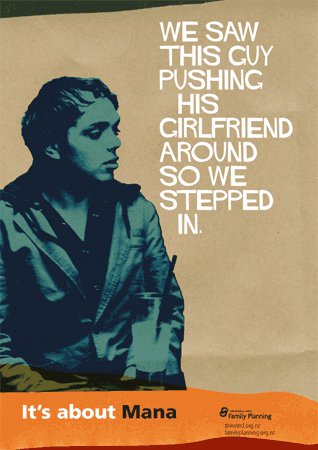
It's all about Mana


Family Planning NZ has picked up an overseas idea and made it their own (think this is called ‘contextualization’ – one word I’ve learned while working at National Mission! LOL).
They’re calling the programme It’s about Mana, and it’s intended for young men – those in the later stages of schooling and beyond – with the hope that they’ll question traditional male values: the idea that real men are always in control (but have uncontrollable sex drives); deserve entitlement or respect, and that women are objects, amongst other things. Holding these ideas up to the light is intended to work against relationship violence. “If young men are involved in discussions that show that most men don’t use or condone violence towards women, this will make it harder for violent individuals to justify it as normal behaviour.”
Read more on the Family Planning site or join the Facebook page.

And more on the same topic. There’s a very interesting report from the International Planned Parenting Federation called Men are Changing. While personally I’ve had some qualms in regard to the work of the IPPF over the years, this report is essentially positive and shows that a great deal of important work is being done in regard to the way men see themselves and their relationships to women - and other men. The interesting thing about this report is the case studies for once don’t come from European or North American contexts (there is a Canadian one) but from African, South American and Asian countries.
You can download the pdf here.